


Quick facts
Overview
The highly prospective Beetaloo Sub-basin comprises large undeveloped shale gas resources and represents a structural sub-basin within the greater McArthur Basin that preserves a thick succession of highly prospective Mesoproterozoic Roper Group stratigraphy.
Exploration and appraisal activities continue to expand and refine substantial shale gas contingent resources within the Beetaloo Sub-basin, with ongoing drilling, hydraulic fracturing and production testing demonstrating the scale and technical recoverability of the shale gas resource across the sub-basin. Appraisal drilling and flow-testing of lateral wells up to 3000m in length is supporting progression of the sub-basin toward pilot production in 2026 and future large-scale commercial development.

The sub-surface Beetaloo Sub-basin lies within the McArthur Basin and comprises thick sequences of sedimentary and minor volcanic rocks assigned to the following stratigraphic groups or their equivalents: the Palaeoproterozoic Tawallah and McArthur groups, and the Mesoproterozoic Nathan and Roper groups, which hosts the majority of petroleum occurrences.
The key shale targets within the Beetaloo Sub-basin are the organic-rich Velkerri and Kyalla formations of the Mesoproterozoic Roper Group, which are recognised as some of the most prospective shale gas units in Australia. The Velkerri Formation, the primary exploration target to date, is laterally extensive across much of the basin and consists of thick, silica-rich marine shales with high total organic carbon content and favourable reservoir properties for hydraulic fracturing. In many areas, the Velkerri exceeds 500 metres in thickness, with the most prospective middle Velkerri shale interval commonly occurring at depths of approximately 1,500 to 3,000 metres. The overlying Kyalla Formation also contains thick organic-rich shales and liquids-rich potential in some areas, providing an additional exploration target.
Information on the geological setting of the McArthur Basin can be found in the McArthur Basin inventory.
Petroleum
The Beetaloo Sub-basin is Australia’s premier shale gas play, with demonstrated prospectivity increasing as exploration accelerates. The Beetaloo Supersystem contains at least four conventional and unconventional petroleum systems with substantial shale gas resources primarily within the Mesoproterozoic Roper Group. The most prospective shale units in the Roper Group occur within the Velkerri and Kyalla formations, most notably the B-shale of the Amungee Member of the Velkerri Formation. Drilling of the middle Velkerri Formation has demonstrated the consistent presence of gas saturated, quartz-rich shale source rocks that are mature for gas over extensive areas, and meet all of the physical and chemical parameters for a successful shale gas play (see Revie 2017). The shallower Kyalla Formation also has high potential as a productive shale play, with large areas within the wet gas window.
The Beetaloo’s shales are considered highly favourable for unconventional gas development. Combined with the basin’s scale, thermal maturity and stacked shale intervals, the geology of the Beetaloo Sub-basin has drawn comparisons with North America's Marcellus shale gas play.
Download the Shale gas and liquids factsheet PDF (1.9 MB).
Other energy potential
Minor hydrogen gas shows have been historically recorded from the Beetaloo Sub-basin.
Mineral commodities
For an overview of the mineral prospectivity view the Geology of the Northern Territory Chapter 15 McArthur Basin.
Early exploration (1987-1993)
The earliest petroleum exploration in the Beetaloo Sub-basin was in the late 1980s by Pacific Oil & Gas (POG), a subsidiary of CRA Exploration Pty Ltd, following up on the identification of ‘live’ oil in the stratigraphic well Urapunga 4, drilled by the Bureau of Mineral Resources in 1985. From 1987 to 1993, POG drilled 12 wells in the Sub-basin, although only four penetrated the Velkerri Formation. POG also completed 2425 km of 2D seismic to help target structural closures and conventional oil and gas plays. No significant conventional accumulations were discovered, but the wells identified the presence and continuity of the organic-rich shales of the middle Velkerri Formation as well as bitumen and degraded oil shows within the Bessie Creek Sandstone.
Identification as a shale gas play (2007-2012)
After POG exited the Sub-basin in 1993, no further activity occurred for over a decade, until Sweetpea Corp. commenced exploration in the mid-2000’s, targeting a combination of conventional oil and gas plays as well as tight gas and basin-centred gas plays. Sweetpea completed 700 km of 2D seismic before drilling Shenandoah-1 in 2007, suspending the well at 1555 m within the lower Kyalla Formation. Through a series of transactions, Falcon Oil and Gas subsequently became operator of the permits in the late 2000s, having recognised the potential of the Velkerri Formation as a potential shale gas play. Falcon deepened Shenandoah 1 to the Velkerri Formation (Shenandoah 1A) and then in 2011, completed one of the earliest hydraulic fracture stimulations of a shale gas play in Australia. Falcon successfully flow tested two zones within the middle Velkerri Formation, and one zone in the Kyalla Formation. Hess Corporation farmed-in to the tenure in 2011 and acquired over 3500 km of 2D seismic in 2011-12 before exiting in 2013.
First phase of systematic shale gas exploration (2013-2016)
A major phase of exploration and appraisal occurred across the basin from 2013 to 2016. In 2014, Santos drilled the deepest well in the basin, Tanumbirini-1 (now Mount Brown-1) by to a total depth of 3946m. In the western Beetaloo Sub-basin, Pangaea Resources Pty Ltd acquired 1800 km of 2D seismic and drilled 5 exploration and appraisal wells and 2 stratigraphic wells between 2013 and 2016.
In 2013, Origin Energy and Sasol Ltd farmed into Falcon Oil and Gas’s acreage, and in 2015 the joint venture drilled two exploration wells (Kallala S-1 and Amungee NW-1, along with the first lateral well in the basin at Amungee NW-1. In 2016, Origin undertook the first horizontal fracture stimulation in the basin, with 11 stages stimulated over an 1100m horizontal section in the middle Velkerri Formation. In December 2016, a 57-day extended production test was completed, with production averaging 1.10 MMscf/d, demonstrating the potential productivity of the Velkerri Formation.
Appraisal of production potential (2019-present)
Exploration paused in the basin during the 2016-2018 moratorium on hydraulic fracturing. Following the lifting of the moratorium in 2018, drilling recommenced in the basin in 2019 with Origin Energy spudding the Kyalla 117 N2-1 well, designed to test the liquids-rich Kyalla shale play. Also in 2019, Santos re-entered the Mount Brown-1 vertical well and commenced a fracture stimulation program. In 2020 Empire Energy (now Beetaloo Energy Australia) drilled their first well at Carpentaria-1, near the eastern edge of the Sub-basin,
Since 2021, the focus in the Beetaloo Sub-basin has been on drilling and testing of horizontal appraisal wells, with increasing application of US shale technologies and expertise. This has transformed the basin from a speculative frontier shale play to being a demonstrated world-class shale gas basin. In 2022, Tamboran Resources acquired Origin Energy’s share of their tenure in the Beetaloo, and US-based Formentera Partners entered the basin through their subsidiary Daly Waters Energy, as part of a joint venture with Tamboran.
Activity since 2024 has increasingly focussed on potential pilot production sites at Shenandoah South (Tamboran-Daly Waters) and Carpentaria (Beetaloo Energy Australia), with multiple lateral wells up to 3000m (10,000 feet) in length being drilled off single pads with increasingly successful flow rates from production testing (see table below). Pilot production from Tamboran Resources’ Shenandoah South site is due to commence in September 2026, with production from Beetaloo Energy’s Carpentaria site also planned by the end of 2026.
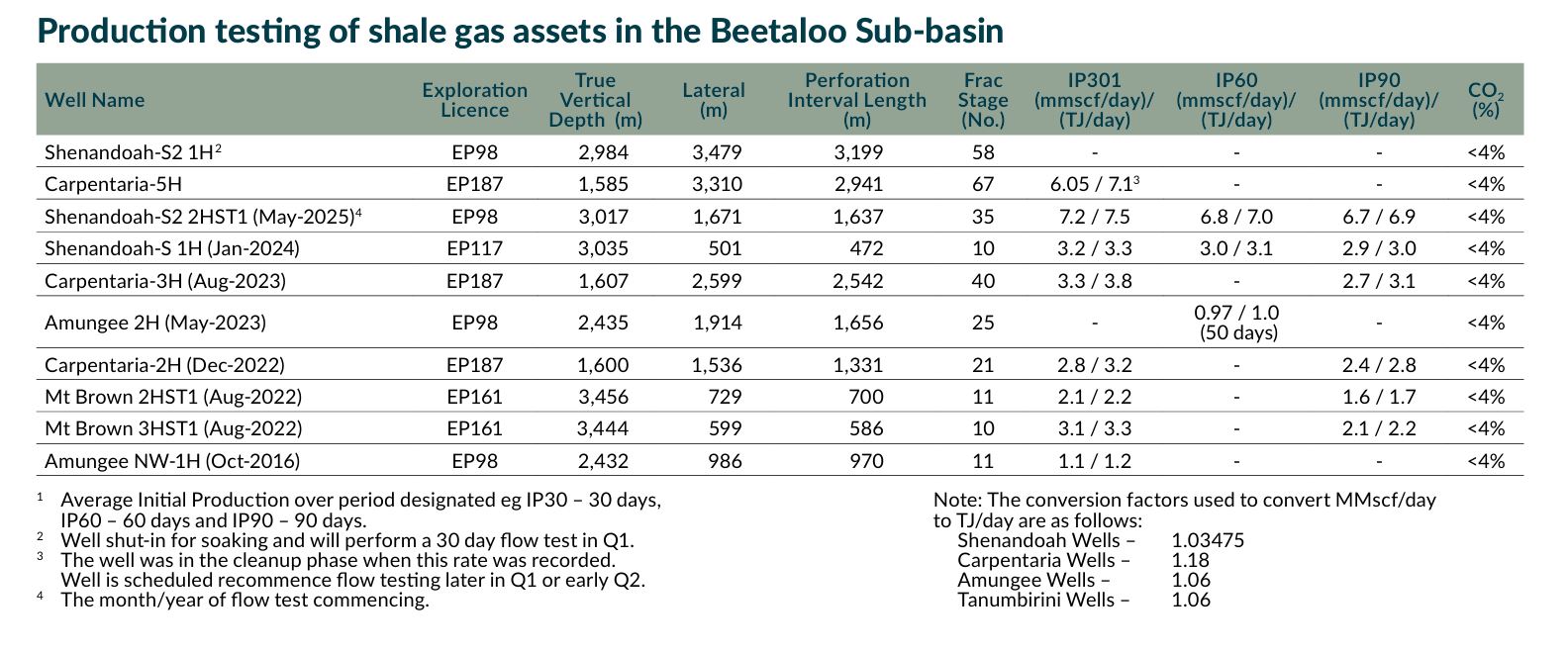
Exploration and appraisal continue to accelerate with Contingent Resources (2C) growing and a number of wells undergoing appraisal by key operators in the Beetaloo Sub-basin.
The following table contains publicly announced best estimate of Contingent Resources (2C) in the advanced Beetaloo Sub-basin in accordance with the SPE-Petroleum Resources Management System. For a summary of Prospective Resources (P50) in the Beetaloo Sub-basin, download the Shale gas and liquids factsheet PDF (1.2 MB)
| Formation | Permit | Well/s | Resource | Gross Contingent Resources 2C | Operator |
|---|---|---|---|---|---|
| Velkerri Formation | EP187 | Carpentaria 1, 2, 3, 5 | Shale gas (Bscf) | 1467 | Beetaloo Energy Ltd |
| Velkerri Formation | EP167, EP168 | Birdum Creek 1, Tarlee 1, Wyworrie 1 | Shale gas (Bscf) | 158 | Beetaloo Energy Ltd |
| Velkerri Formation | EP167, EP168 | Birdum Creek 1, Tarlee 1, Wyworrie 1 | oil (MMbbl) | 3.5 | Beetaloo Energy Ltd |
| Velkerri Formation | EP76, EP98, EP117 | Amungee NW 1,2,3, Shenandoah South 1,2, Kyalla 117, Velkerri 76 | Shale gas (Bscf) | 3215 | Tamboran B2 Pty Ltd1 (77.5% net share)2 |
| Velkerri Formation | EP161 | Mt Brown 1,2,3 | Shale gas (Bscf) | 1880 | Santos Ltd (75% net share)3 |
| Velkerri Formation | EP136 | Maverick | Shale gas (Bscf) | 406 | Tamboran Resources Ltd (100% net share) |
Additional resources can be found in the McArthur Basin inventory .
1 Tamboran B2 Pty Ltd comprises Tamboran Resources Pty Ltd (50%) and Daly Waters Energy (50%)
2 Falcon Oil & Gas Australia comprise 22.5% net share
3 Tamboran Resource Pty Ltd comprise 25% net share
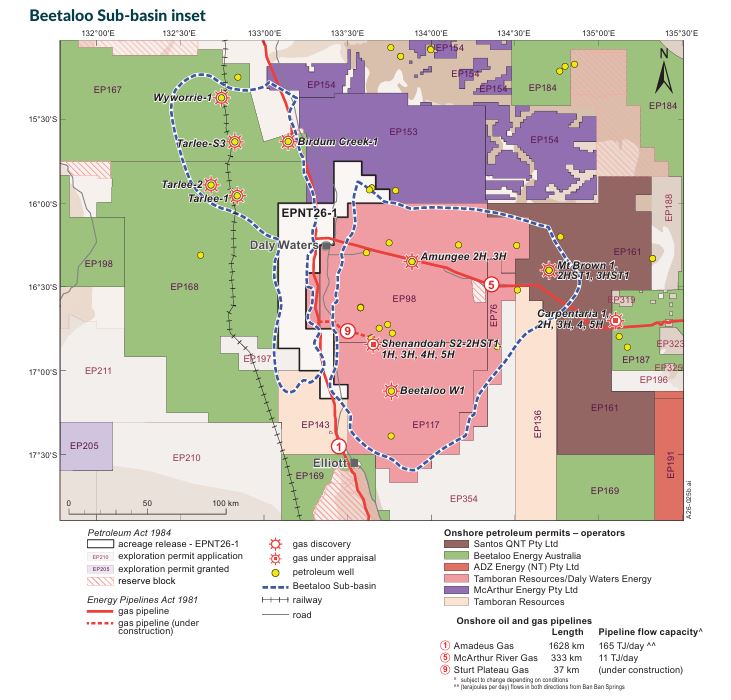
The Beetaloo Sub-basin has the most extensive seismic coverage of all NT onshore basins and concentrated exploration wells drilled.
Open file petroleum company reports and all NTGS data and information on the Beetaloo Sub-basin is available from the GEMIS website.
Munson, TJ, 2014 NTGS Report 22: Petroleum geology and potential of the onshore Northern Territory
Williams, B, 2019, NTGS Record 2019-015: Definition of the Beetaloo Sub-basin